Reading Focus
Reading Update Letter to Parents Feb 2022
Learning to read is the one of the most important thing your child will learn at our school. At Bledington Primary School every child experiences a high quality of teaching reading, through phonics, individual 1:1 reading, guided reading and whole class shared reading.
Phonics
At Bledington, we teach phonics based on Letters and Sounds and the National Curriculum. In the Foundation Stage and Key Stage 1, we start by teaching single phonemes and use this knowledge to start blending straight away, because we are aware it is important for children to be aware of how sounds work and how they relate to words. Then we move onto teaching digraphs (2 letters making 1 sound) and trigraphs (3 letters making 1 sound). We also work on building sight vocabulary, including common exception words (which are words that are spelt in an uncommon or unusual way) and high frequency words. We do this through practical, hands on activities like rhyming words strings, games, jigsaws, nursery rhymes and caption activities.
Foundation Stage and Key Stage 1 Reading
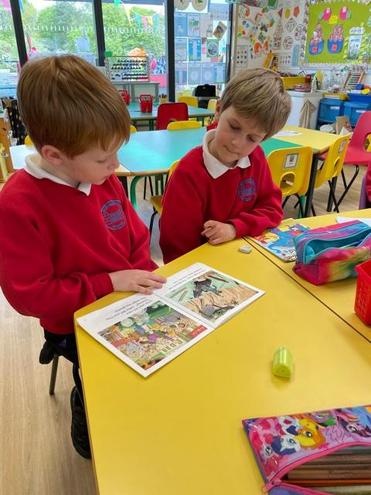
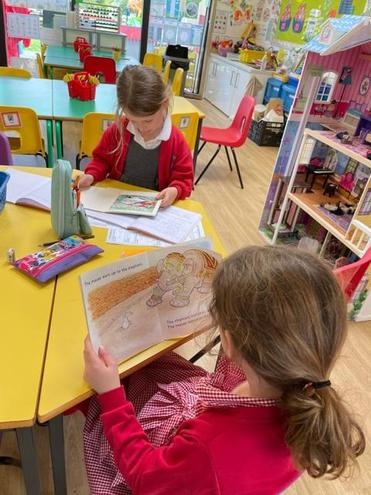
The books in these stages are grouped (banded) by level/colour. There are 10 different levels and each level contains a large number of books from different publishers such as Oxford Reading Tree, Oxford Literacy Web, Collins Big Cats, Songbirds, Fireflies and Walkers.The books are grouped linked to their phonic and tricky word content.
Your child will learn to read on an individual basis, in group work (guided reading) and on a whole class basis. They should bring their reading homework into school and then it will be returned home everyday. This is important for continuity and progression when they read to adults or if they read silently in class. We encourage the children to empty their bags every morning so they have access to their books and reading record. We will change books on a Monday, Wednesday and a Friday; this allows your child to reread the book (to practise their fluency, expression and word recognition) and complete a task linked to their book.
How do we teach Individual Reading? -
Children in Foundation are working towards the Early Learning Goals.
In reading these are:
- Children read and understand simple sentences
- Children use phonetic knowledge to decode regular words and read them aloud accurately
- They read some common irregular words
- They demonstrate understanding when talking with others about what they have read
We take the following approach
- Introduce the sounds of the letter of the alphabet and then the diagraphs as laid out in Letters and Sounds
- Teach children phoneme/grapheme correspondence (say and hear)
- Teach the children to blend for reading and then segment for spelling
- Teach High Frequency Words (Tricky Words)
- Reading starts by learning the format of a book, including how to hold it and tell a story using the pictures
- Introduce the children to reading books that are phonetically de-codable, when they are blending, that they will read with their parents
- As you child progress through the different levels the books become more complex in the quanity of reading and their complexity of language
- Each child will participate in Story Time, Guided Reading or Big Book lessons to reinforce vocabulary/fluency/comprehension/understanding/reading skills
We use a variety of strategies to help your children lean to read:
- Sharp Eyed Owl - Look at the pictures for clues
- Tommy Tracker - Point to each word as you read it
- Sound it Parrot - Say each sound to work out the word
- Don't Forget Elephant - Use your memory! Where have you seen the sound before?
- Slide the Snake - Blend the sounds together
- Chunky Monkey - Look for chunks in the word to work it out
- Mouse the Mouth - Say the first sound
- Flippy Dolphin - Flip the vowel from short to long
- Try the Fly - Try a word that makes sense
- Hop, Skip & Jump Kangaroo - Read to the end and come back again


Key Stage 2 Reading
The books for KS2 are grouped (banded) by level/colour. There is a large selection of books in each of the levels.
- Free Reader 2 - Orange
- Free Reader 3 - Blue
- Free Reader 4 - Yellow
- Free Reader 5 - Green
- Free Reader 6 - Red
- Free Reader 7 - Brown
- Free Reader 8 - Purple
We have also a non-fiction section to our library, which are organised by subject rather than reading level, and our pupils have access to. After responding to the pupil's view we have started updating and adding to our selection of books and would like to give a great big thank you for the donations and purchases made up to now.
In Key Stage 2, your children will be learning to read on an individual, group and whole class basis. They should bring their reading homework into school and then it will be returned home everyday. We will change books on a Tuesday and Thursday; this allows your child to read the book and complete a written task linked to comprehension, inference or analysis skills.
Parental Involvement
We acknowledge that it is the job of school staff to teach a child how to read and to deveop as a reader. However, we know that the best readers will also be reading within the home environment. Therefore, parents are encouraged to read with their children every day and write in their reading record: therefore it is important that these are checked regularly, so that the teachers can respond and show parents that we really do value their contribution. Teachers/Teaching Assistants should write a comment about your child a least weekly.
If children do not have an opportunity to read at home, the staff in Foundation and Key Stage 1 will try to give the children an opportunity for 1:1 reading with an adult (Teacher/TA/Volunteer)
Questioning Techniques linked to Reading
Lost/Damaged Books
We check the books annually, but if you notice a book has missing pages or is damaged when your child brings it home please return it to school and we will remove it from our library then replace it. We understand that accidents do happen. However, due to reduction in school budgets, if a book is lost or damaged in your child's care we will (using our discretion) give you the options of either to replace the book yourself or pay between £3 to £5 (depending on its value) for the school to replace the book.
Guided Reading
Your child will have Guided Reading sessions in Owl Class and Penguin Class each week; one of which will be supported by a teacher, another with a TA and may also include independent support reading tasks. These sessions will be developed around identified "quality reading books" suitable for the year groups. Parrot Class develop their reading skills linked to topic work and class novel.
Book Corners
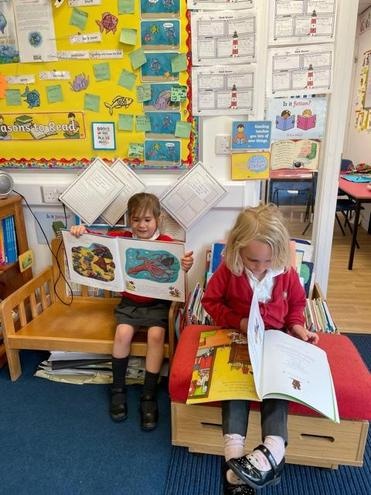
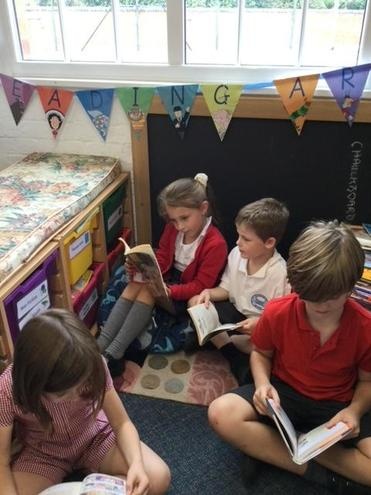
All classrooms have reading areas, which include a range of books (fiction, non-fiction, dictionaries, atlases... to list just a few) and reflect both genders and cultural diversity. They are also comfortable and inviting, with optional tasks for pupils.
Story Time
There should be story time in all classes everyday, so children can hear and see how a good reader sounds. It is a time for children to enjoy books, while providing language rich expeiences and opportunities to develop vocabulary and comprehension skills.
Assessing & Checking
We will check your child's progress on a termly basis. We will record what they can do linked to the EYFS and the National Curriculum. We use word checks, miscue tests (assesses the percentage of accuracy and fluency) and the Oxford Reading Criterion Scale (focuses on comprehension and word knowledge) to assist identifying where we need to focus your child's learning. This looks at skills linked to READ.
READ = word reading and general reading behaviour
- R = Recall and retrieve information
- E = Exploring the author's language and point of view
- A = Analysis of structure and organisation
- D = Deduction and inferance
Vounteers
We are very lucky to be part of the Volunteer School Reading, which means we have three adults from the community, who come into Bledington to read with the children in Owl and Penguin class. We also have other parent volunteers who come into school to read with our pupils. If you would like to volunteer, please speak to your child's class teacher or Mrs Bell.
Please note: all parents who volunteer in schools must have a current DBS check. Mrs Logue can help you with this.
Book Ideas
It is fantastic to read a range of genres in books, including books written by the authors you love and new, up and coming authors. There are lots of excellent reading books available for your child to read. Below are some links for the book trust website to inspire a love of reading.
Below there is also an additional link to the booktrust website which will allow you to take a look at their picks of the best books for 0-5 year olds, 6-8 year olds, 9-11 year olds and 12-14 year olds which have been releasing in the past 100years.
- New AuthorsYou can browse the most recent booklists to keep up to date with new authors
- Best Books of the Month Choose the best books they have selected each month